Give conversations a defined purpose
Assess product explanations, understanding of needs and next steps separately so the team can judge whether the assistant supports the work.

 Not Bad Req(uest)繁中Discuss a project
 Evaluate product advice and conversational service through a voice prototype, including knowledge, response quality and handoff requirements.
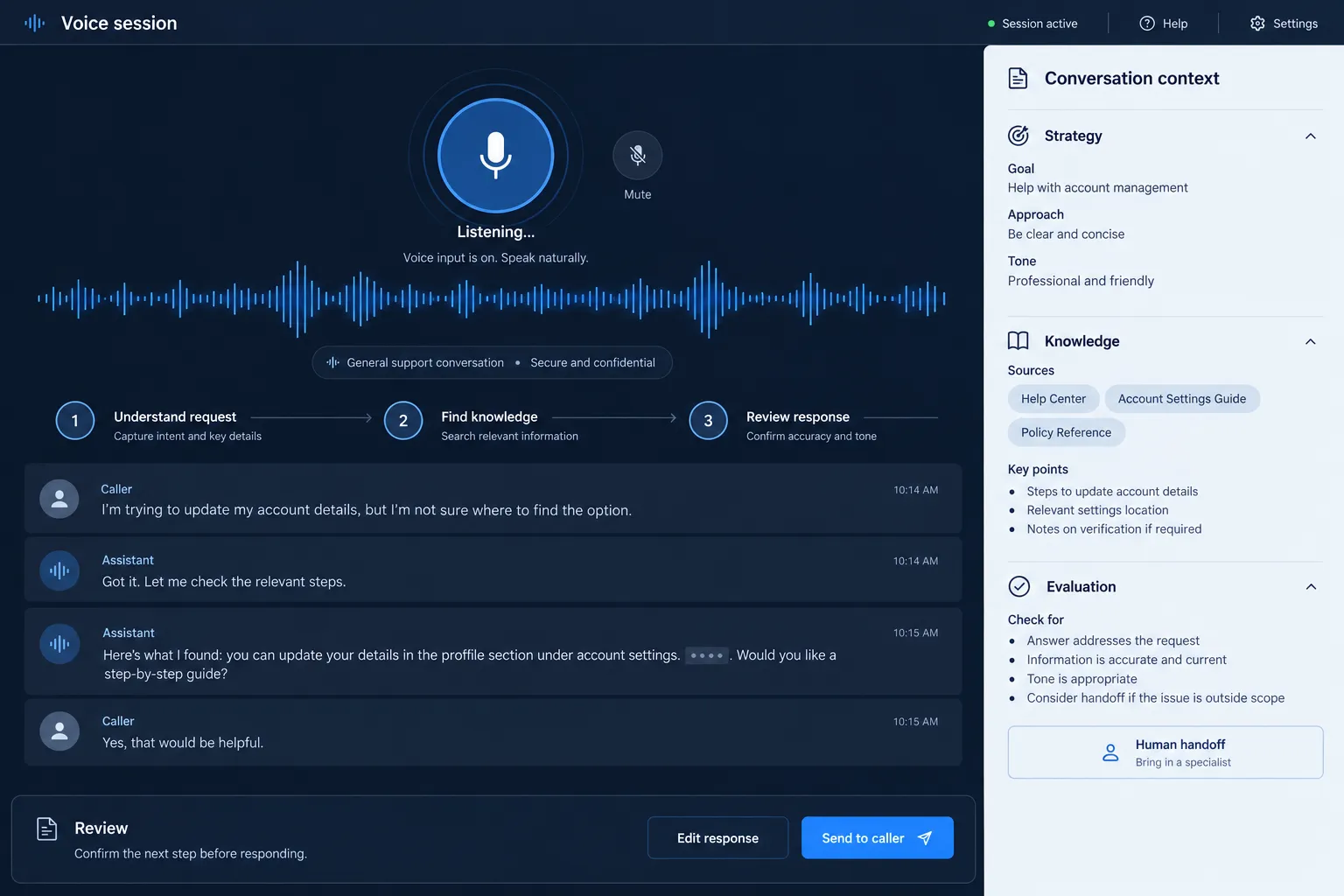
Voice assistant console with waveform, conversation context, knowledge and human handoff
Product inquiries and sales conversations require understanding needs, finding information and maintaining context. When preparation, live responses and later evaluation are mixed together, it is difficult to assess accuracy, task completion and situations that require a person to take over.
This AI proof-of-concept experience combined real-time voice, product knowledge, conversation strategy and evaluation. The result is a testable conversation prototype, rather than evidence of production operation in a support center or sales workflow.
AI prototype validation
Assess product explanations, understanding of needs and next steps separately so the team can judge whether the assistant supports the work.
Compare responses and conversation behavior in consistent scenarios to identify knowledge or workflow changes.
Define confirmation and handoff situations so future integration fits support and sales responsibilities.
Planning considerations for a similar project; the actual scope follows your data, existing resources and operating requirements.
For similar needs, existing product knowledge and available voice services can support one conversation task before business-system integration is assessed. Response speed, concurrent usage and conversation length affect operating costs and should be evaluated alongside quality and human handoff.
Start with one task in simulated scenarios, checking information accuracy, speech understanding, response delay and when people should take over. Use the agreed task evaluation before deciding on live workflow integration. This stage also clarifies the time needed for communication interfaces, voice scenarios and operational participation.
Choose one task and prepare simulated scenarios and reference responses. Build a voice or text prototype for human evaluation before deciding whether to connect it to actual business workflows.
Discuss this directionShare your business need, workflow or product idea. Start with an initial conversation to discuss a suitable scope and next step.
Request a free initial conversation Further analysis and development follow an agreed scope.